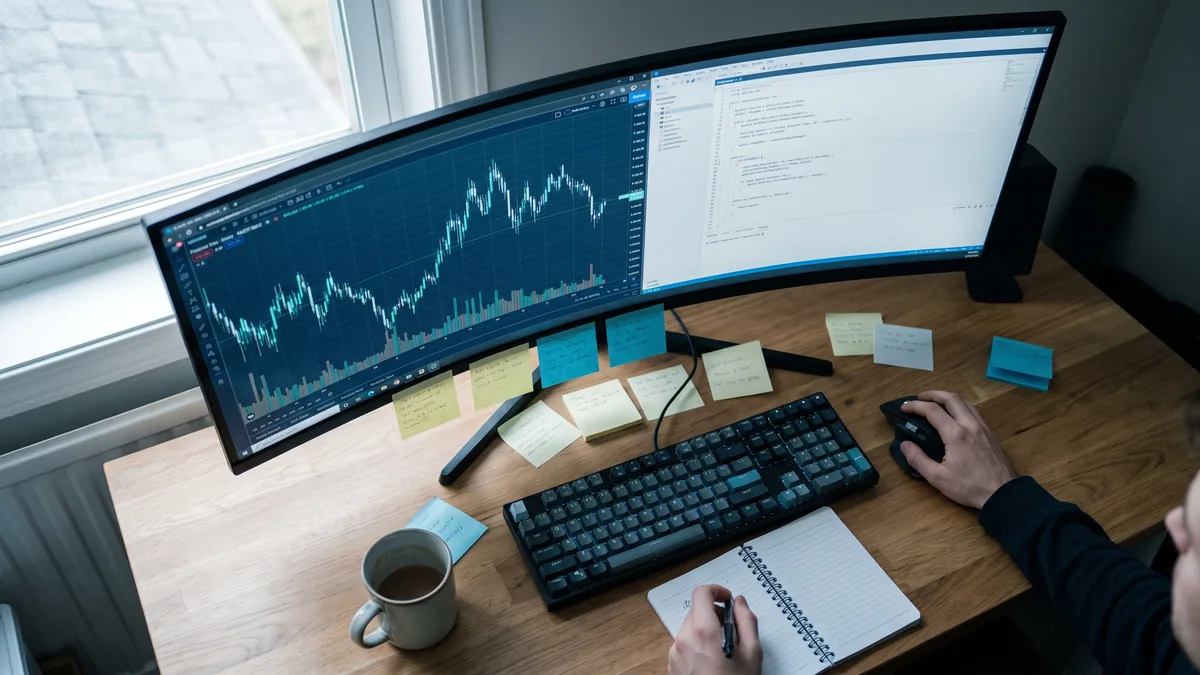
Can AI Help You Pass a Prop Firm Challenge
Learn where prop firm challenge AI helps most, how to control risk to meet drawdown rules, and build a repeatable plan for an AI funded account.
By Trading AI Team

Key Takeaways
- Prop firm challenge AI is most useful for enforcing risk limits and filtering trades, not for “predicting” the next candle with high accuracy.
- Capping risk to 0.25%–0.75% per trade and using hard daily stops is the most common way to survive strict max-drawdown rules.
- You can pass prop firm challenge rules faster by trading fewer, higher-quality setups and avoiding news spikes that distort spreads and slippage.
- AI improves consistency when it automates a checklist: trend filter, volatility filter, entry trigger, stop logic, and kill-switch conditions.
- The best path to an AI funded account is proving discipline first, then scaling size only after stable execution metrics.
Most traders fail challenges for one reason: they trade like it’s their personal account. A prop evaluation is a rules-based endurance test, and AI can help—if you use it to reduce mistakes, not to chase signals.
How Prop Firm Challenges Actually Fail Traders
Prop firms don’t need you to be a market wizard; they need you to respect risk. The common failure pattern is one big red day or a cluster of revenge trades that trips the daily loss or max drawdown.
The rules that matter more than the profit target
Most challenges are framed around a profit target (often 8%–10%), but the account is governed by risk ceilings:
- Daily loss limit (example: -5% in a day)
- Max drawdown (example: -10% overall, sometimes trailing)
- Minimum trading days (forces patience and avoids “one-shot” gambling)
- Consistency rules (some firms cap single-day profit contribution)
Actionable tip: Write your rules as a “risk budget” per day. If your daily loss limit is 5%, don’t “trade up to 5%.” Set a hard stop at 2.0%–2.5% to leave room for slippage and execution errors.
The hidden killers: spreads, slippage, and correlation
A lot of failures are not strategy-related:
- Trading news on EUR/USD during CPI/ECB can widen spreads and cause stop-out even with a correct directional idea.
- Correlated exposure (e.g., long BTC and long ETH and long COIN) behaves like one oversized bet.
- Trailing drawdown models punish “give-back” even if you’re still green on the day.
Actionable tip: Treat correlated trades as one position. If you’re long BTC and ETH, reduce size so combined risk stays within your per-trade limit.
Where AI Helps Most in a Prop Firm Evaluation
The best use of AI in a challenge is as a process enforcer. Think of it as a trading ops manager that prevents you from breaking your own rules.
AI as a risk governor, not a signal vending machine
Using prop trading AI purely for entries often creates overtrading. Using it for guardrails tends to improve your pass rate:
- Auto-calculate position size from stop distance and max risk
- Block trades when volatility spikes beyond your plan
- Enforce “no-trade windows” around scheduled news
- Detect when you’re deviating (bigger size, wider stops, more trades)
Actionable tip: Make AI deny trades unless three conditions are met: (1) trend filter aligns, (2) stop distance is inside your max, (3) expected R multiple is at least 1.5R.
Pattern recognition that actually matters: regime and volatility
AI is useful at classifying regimes like trend vs range and low vs high volatility. This matters because many challenge blow-ups happen when traders apply the same sizing in a totally different regime.
Examples:
- AAPL in a strong trend: pullback entries with tighter invalidation can be efficient.
- EUR/USD in a choppy range: mean reversion works, but stops must reflect noise; otherwise death by a thousand cuts.
- BTC during high-volatility sessions: your “normal” stop may be too tight by 30%–60% based on ATR.
Actionable tip: Use ATR-based stops (e.g., 1.2× ATR(14)) and let AI flag when ATR expands > 25% vs the 20-day average, reducing size automatically.
Journaling and error tagging at scale
AI can categorize trades by setup, session, and mistake type faster than manual journaling. That’s not glamorous, but it’s how you stop repeating the same error.
Useful tags:
- “Entered late” (chased breakout)
- “Moved stop” (rule break)
- “News trade” (spread spike)
- “Correlation overload” (stacked risk)
Actionable tip: Review the last 30 trades and force AI to produce a “top 3 mistake list” with frequency counts. Fix the highest-frequency mistake first.
A Practical AI Assisted Challenge Trading Plan
A challenge plan should be boring, repeatable, and designed to avoid rule violations. Here’s a framework you can adapt whether you trade crypto (BTC, ETH), forex (EUR/USD), or stocks (AAPL).
Step 1: Choose one market and one session
Most failures come from context switching. If you trade EUR/USD London session, don’t suddenly swing trade AAPL earnings week.
- Forex: pick EUR/USD or GBP/USD and one main session
- Crypto: pick BTC and trade specific windows (e.g., NY open)
- Stocks: pick liquid large caps like AAPL, MSFT, NVDA during regular hours
Actionable tip: Limit yourself to one primary instrument + one backup. Fewer charts means fewer impulsive trades.
Step 2: Define your risk model for the evaluation
A challenge is not the time to “find out” your max pain. A stable baseline:
- Risk per trade: 0.25%–0.75%
- Max trades per day: 1–3
- Daily loss stop: 1.5%–2.5% (even if the firm allows 5%)
- Weekly loss stop (self-imposed): 4%–5%
Actionable tip: If you lose 2 trades in a row, stop for the day. This rule alone prevents most “tilt spirals.”
Step 3: Use AI to enforce a trade checklist
Build a simple checklist and let AI score it “pass/fail” before you place the trade.
Example checklist (trend-following on EUR/USD):
- Higher timeframe bias: price above/below 200 EMA on H1
- Volatility: ATR not in top 20% of last 30 days
- Entry trigger: break-and-retest of a clean level
- Stop: beyond structure, max stop distance capped
- Target: minimum 1.5R, partial at 1R optional
Actionable tip: If the checklist score is below 4/5, it’s a no-trade—no exceptions.
Step 4: Set “kill switches” for drawdown protection
This is where prop firm challenge AI shines. Your kill switches should be mechanical:
- Lock trading after daily stop is hit
- Block new positions when spread widens beyond normal (e.g., EUR/USD spread > 2.0 pips)
- Reduce size by 50% after a losing streak of 3
- Disable trading around major news (e.g., 15 minutes before to 15 minutes after)
Actionable tip: Add a “profit lock” rule: after you’re up 3%, reduce risk per trade by 30%–50% to protect equity and avoid give-back.
Example Setups With AI Filters (BTC, EUR/USD, AAPL)
You don’t need 12 strategies. You need 1–2 setups that fit challenge constraints and can be executed cleanly.
Setup 1: BTC trend pullback with volatility filter
Market: BTC
Timeframes: H1 trend, M15 entry
Logic: Trade with trend after pullback to a moving average or prior level.
- Trend filter: H1 price above 200 EMA (longs only)
- Pullback: price retraces to 20 EMA or prior breakout zone
- Entry trigger: M15 bullish engulfing or break of pullback high
- Stop: below pullback low, but capped at 1.3× ATR(14)
- Target: first target 1.5R, optional runner to 2.5R
How AI helps:
- Flags “ATR expansion” days and cuts size
- Detects when BTC and ETH correlation is high and prevents doubling exposure
Actionable tip: If BTC’s 1-hour ATR is >30% above its 20-day median, trade half size or skip; challenges punish volatility surprises.
Setup 2: EUR/USD range fade with news avoidance
Market: EUR/USD
Timeframes: H1 range, M5 entry
Logic: Fade extremes in a defined range when momentum stalls.
- Range definition: H1 support/resistance tested at least 2 times
- Entry: M5 rejection wick + close back inside range
- Stop: just outside range boundary (tight but structural)
- Target: midpoint of range first, opposite boundary second
How AI helps:
- Auto-blocks trades during high-impact events (CPI, NFP, ECB)
- Monitors spread and slippage conditions at session opens
Actionable tip: If you take a range fade, don’t add to losers. One entry, one stop, done—prop rules punish “averaging down.”
Setup 3: AAPL breakout with position sizing discipline
Market: AAPL
Timeframes: H4 levels, M15 entry
Logic: Trade breakout of a clean level after compression.
- Identify a level: prior H4 high with multiple touches
- Confirm compression: shrinking ATR or narrowing range for 5–10 candles
- Entry: M15 close above level + retest hold
- Stop: below retest low
- Target: measured move or 2R target
How AI helps:
- Screens for “false breakout” environments (broad market chop)
- Adjusts size based on stop distance and max risk budget
Actionable tip: Avoid breakouts 5 minutes before major economic releases; spreads and liquidity shifts can invalidate technicals even in liquid names.
Tools and Workflows That Fit Prop Rules
If you’re trying to pass prop firm challenge requirements, the workflow matters as much as the setup. Here are practical components that align with evaluation constraints.
AI analysis and checklists
- Trading AI app checklist mode
- Pre-trade volatility and spread monitor
- News calendar trade blocker
Actionable tip: Run a 60-second pre-trade routine: “Rule check → size check → correlation check → news check.” If any fails, you skip.
Risk and journaling stack
- Risk calculator with fixed fractional sizing
- Trade journal with mistake tagging
- Equity curve and drawdown tracker
Actionable tip: Track “rule violations per week” as a metric. Your goal is zero, even if performance is average—prop firms reward survival.
The AI funded account mindset shift
An AI funded account isn’t a license to trade more; it’s permission to keep doing what already works. Scaling should be slow and based on execution quality.
Actionable tip: Only increase risk after 20 trades with (1) no daily stop hits and (2) at least 45% win rate with average win bigger than average loss.
Frequently Asked Questions
Can AI help me pass a prop firm challenge faster
Yes, if it reduces rule breaks and overtrading more than it changes your entries. The biggest edge is AI-enforced risk, sizing, and no-trade filters around volatility and news.
What is the best risk per trade for prop firms
0.25%–0.75% per trade is a common range for staying inside daily and max drawdown limits. If your strategy has lower win rate or higher volatility, lean toward 0.25%–0.5%.
Do prop firms allow automated trading or trading bots
Some do and some don’t, and many require disclosure or restrict certain execution methods. You must read the firm’s rules on EAs, APIs, copy trading, and latency arbitrage before trading.
How do I avoid failing a prop challenge on one bad day
Use a hard daily stop like 1.5%–2.5%, limit trades to 1–3 per day, and stop after two consecutive losses. AI can enforce these kill switches so you can’t override them mid-tilt.
References
- CFTC Economic Calendar and U.S. macro release scheduling (for news-risk planning)
- CME Group market education on volatility and risk management concepts
- Public broker education on ATR, position sizing, and spread behavior during news events
External Links
How to Pass Prop Firm Challenges using AI in Trading AI for Prop Firm Traders: Pass Challenges by Fixing Discipline I Let Claude Use a Prop Firm Loophole (Feels Illegal) I Spent $22,000 Testing AI Trading Agents on Prop Firm Challenges — Here is the Brutal Truth Using AI To Pass Funded Trader Evaluations: Part 2